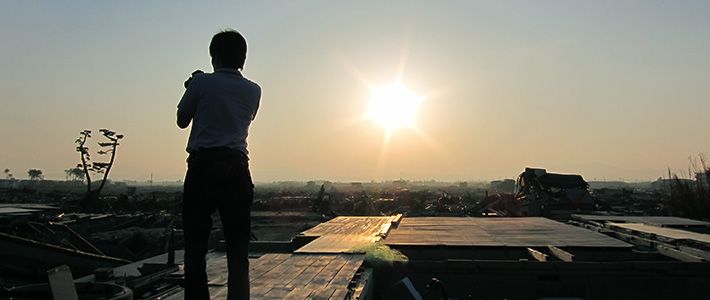

Japan in the Post–3/11 Era: The Road to Rebirth
In the modern era Japan showed itself capable of recovering from natural disaster and the destruction of war to achieve economic greatness. On March 11, 2011, a massive earthquake, tsunami, and nuclear disaster presented the nation with fresh challenges to overcome. What has Japan done so far to bounce back from this blow, and what is the outlook for its full recovery?
Four months on from March 11, journalist Kikuchi Masanori visited areas of Tōhoku devastated by the earthquake and tsunami that struck on that day. Meeting with residents and local leaders, he finds that they are desperate to bounce back from the tragedy and rebuild their lives.
(More)
Kobe 1995 and Tōhoku 2011 were both earthquake disasters, but the first saw most deaths from fires and collapsed homes, while the second was a complex disaster involving a tsunami and nuclear power plant meltdowns. Former director of the Cabinet Intelligence and Research Office Ōmori Yoshio considers Japan’s crisis management in the light of these two events.
(More)
The question on many minds today is what economic ramifications the March 11 earthquake and tsunami will have. This article explores this issue by looking back on the major earthquake the country experienced in 1923 and again in 1995, and considering the impact of those earlier disasters on Japan’s economy.
(More)
Japan now faces the challenge of recovering from the worst natural disaster it has experienced since World War II. But the country needs to do more than simply rebuild the areas hit hardest by the March 11 earthquake and tsunami, argues Professor Yonekura Seiichirō. In this article he critiques the status quo and outlines a vision for a new nuclear-power-free, low-carbon Japan.
(More)
Japan’s public finances had already taken a turn for the worse before the March 11 earthquake, but the situation is likely to become even direr as a result of the disaster. Nariai Osamu, a professor and former government official, considers whether Japan can sort out its fiscal mess while paying for its recovery.
(More)
On March 11, 2011 a massive earthquake and tsunami struck the northeast of Japan. While the people of Japan responded calmly to the disaster and private-sector companies were quick to take part in recovery efforts, the government and the Tokyo Electric Power Company (TEPCO) were widely criticized for a sluggish and ineffective response. This timeline looks back on the half year since the disaster, with a focus on the government response to the nuclear disaster.
(More)
Japan’s Drifting Education SystemThe education system that produced the image of the Japanese as a studious and hard-working people is beset with problems. As well as wreaking havoc on today’s children and university students, the uncertain state of the education system is symbolic of the wider malaise affecting a contemporary Japanese society that seems to have lost sight of its aims.
(More)
How to Safeguard Japan In the Years Ahead: National Security and the Japan-US Alliance
Japan faces a security environment that is undergoing major changes due to such factors as the emergence of China and the recent leadership change in North Korea. This raises the question of how Japan can cope with the growing diversity of risks. This series examines the tasks confronting Japan and explores its recent defense policies, with a focus on the Japan-US alliance.
(More)
Democracy Facing Fiscal CrisisJapan and the leading economies of the West are grappling with fiscal calamity stemming from their ballooning deficits. Do the political systems common to these nations have what it will take to overcome crisis and reduce the red ink? This series of articles examines the ongoing crises from the perspective of democracy.
(More)